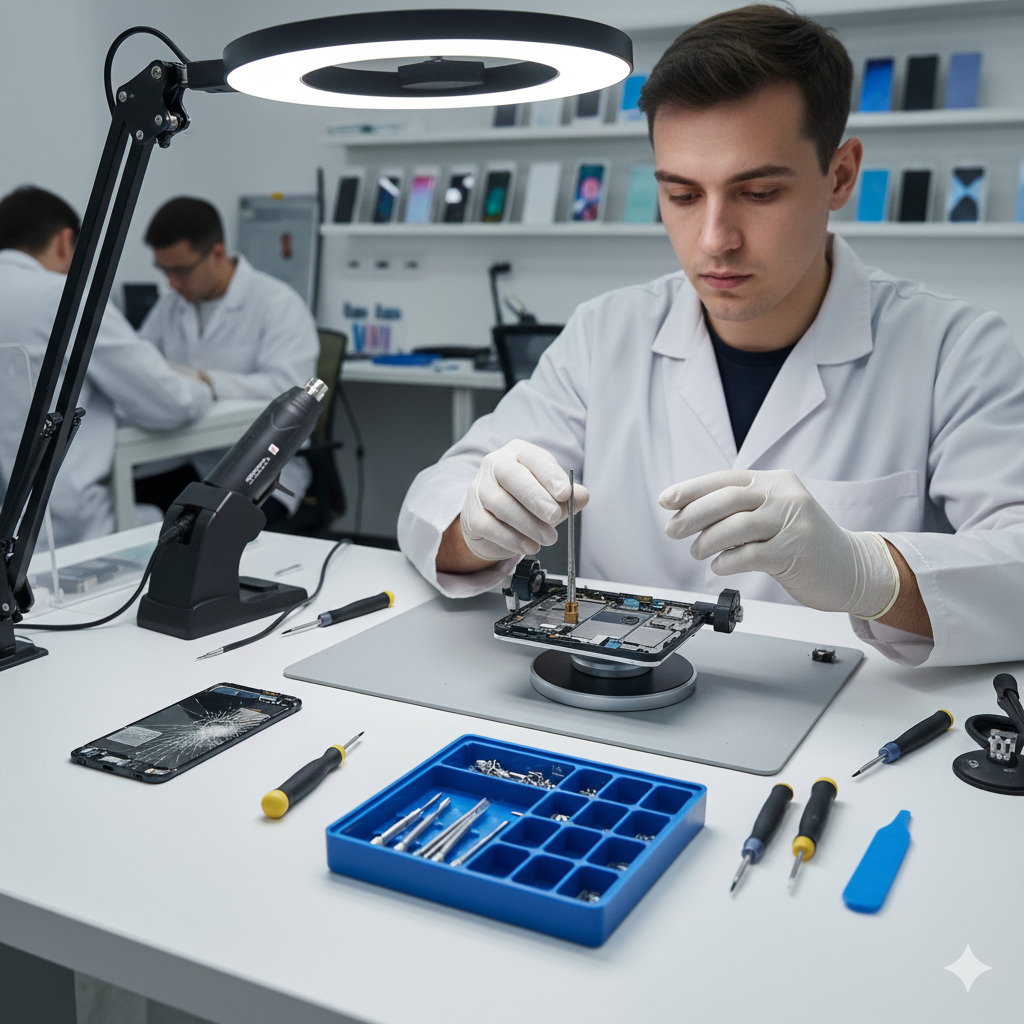
In the aftermarket phone repair ecosystem, consistency is currency. Yet, repair centers and distributors often struggle with OPPO LCD modules that vary in brightness, touch sensitivity, or color tone—even within the same model batch.
Such inconsistency doesn’t just slow operations; it erodes customer trust. Imagine replacing a cracked OPPO display, only for the new one to appear washed out or respond sluggishly to touch. The problem rarely lies in assembly—it starts at the supply chain level.
For repair networks handling hundreds of OPPO devices weekly, even minor quality variance can cascade into costly returns and lost labor hours.
An OPPO LCD display is more than a glass panel—it’s a multi-layered precision system. Beneath the touch digitizer lies:
A backlight plate calibrated for even luminance.
A polarizer film aligned to eliminate glare and distortion.
A driver IC tuned for response time and power efficiency.
A flex cable ensuring seamless signal flow to the motherboard.
When any one of these components deviates from factory tolerances, the visual experience changes. For wholesale suppliers, maintaining this structural integrity across batches requires not just procurement, but engineering-level quality governance.
| Supply Source Type | Quality Consistency | Scalability | Warranty Support | Ideal Use Case |
|---|---|---|---|---|
| Unverified factory stock | Low | High | None | Price-driven resellers |
| Regional traders | Medium | Moderate | Limited | Local distributors |
| Certified suppliers like CPG | High | High | Full technical support | Professional repair networks |
While unverified suppliers may offer attractive unit costs, each deviation in display calibration introduces long-term instability. CPG, as a certified OPPO LCD display wholesale supplier, integrates both batch testing and electrical calibration to minimize variance, ensuring that what technicians install behaves identically to OEM standards.
At CPG, quality assurance doesn’t end at visual inspection—it begins there. Each OPPO LCD display passes through:
Full-frame touch response mapping to detect latency across edge zones.
Color temperature alignment using spectrophotometric analysis.
Brightness deviation check under variable voltage conditions.
Driver IC compatibility verification with OPPO mainboards.
Aging simulation tests, exposing modules to 500+ power cycles.
This multi-stage process ensures that every shipment—whether 50 or 5,000 units—maintains identical luminance, response time, and physical tolerance.
Partnering with a disciplined supplier like CPG offers measurable operational gains:
Reduced return rates thanks to batch consistency.
Shorter installation time due to exact frame alignment.
Reliable touch sensitivity, preventing post-install complaints.
Predictable stock cycles, improving inventory management.
Dedicated after-sales engineering, ensuring technical traceability.
In a market where repair reliability defines reputation, such consistency becomes a tangible business advantage.
European refurbishers integrating OPPO displays into large-scale device restoration lines.
Middle Eastern distributors needing stable brightness profiles for retail-level resale.
Asian service chains standardizing multi-model repairs under unified calibration metrics.
Independent workshops seeking durable, pre-tested displays for same-day repair.
Each use case demonstrates one truth: operational speed means little without predictable quality.
When sourcing OPPO LCD displays in bulk, professionals should:
Request luminance deviation reports (±3% is ideal).
Verify IC chipset version to match original display logic.
Inspect connector pin layout for compatibility with mainboard sockets.
Ensure anti-static packaging and batch labeling to avoid handling damage.
Partner with suppliers offering cross-model technical support, as CPG does for OPPO’s latest series.
Procurement isn’t just about price—it’s about securing repeatable quality for every installation.
Q1: Why do some OPPO replacement screens show color tint differences?
That’s usually due to inconsistent backlight panel suppliers or incorrect polarizer orientation.
Q2: Can refurbished OPPO LCDs match new display quality?
Only if reassembled with verified components and calibrated under controlled luminance testing.
Q3: How does batch calibration reduce rework?
Uniform displays require no reconfiguration—technicians can install and seal without manual tuning.
Q4: What voltage tolerance is safe for OPPO displays?
CPG modules operate within ±0.1V deviation, ensuring stable brightness across use conditions.
For modern repair chains, success depends on supply reliability as much as technical skill. By providing batch-calibrated, OEM-compatible OPPO LCD displays, CPG empowers global distributors and repair professionals to deliver seamless, visually precise replacements—every time.
To learn more about our certified OPPO LCD display modules or request a quotation, visit CPG LCD’s homepage or connect with our team via the Contact Us page.



